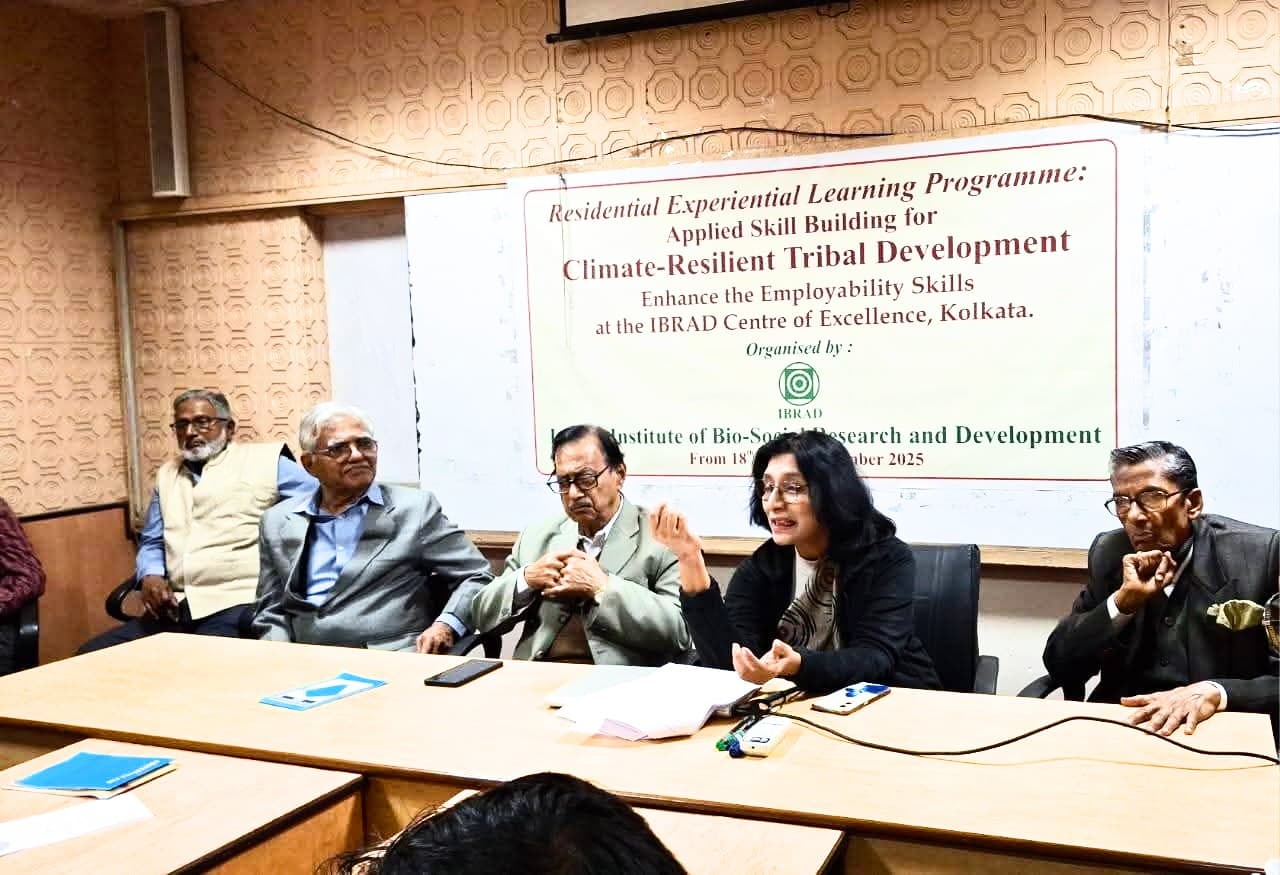
A Lecture for IBRAD Residential Experiential Learning Programme by Somali Panda
Lecture Context
This lecture is delivered within the framework of the IBRAD Residential Experiential Learning Programme on Applied Skill Building for Climate-Resilient Tribal Development.
It integrates Indigenous Knowledge Systems (IKS), sound-based skills, tribal employability, mental health, and climate resilience, with a special focus on Santhal communities.
Opening: Beginning with Listening
Climate resilience is usually discussed through infrastructure, policy, and economics—land, water, housing, and livelihood.
Today, I would like to begin elsewhere—with listening.
Long before climate science, communities listened to forests, rivers, winds, animals, and human voices.
Among Santhal communities, listening has never been passive.
The forest is listened to.
The drum is listened to.
Even silence carries meaning.
Sound is not merely music.
Sound is knowledge, memory, instruction, and survival.
Santhali Insight
A Santhali saying expresses this beautifully:
“Hor hoponre bonga, ror hoponre jibon.”
The forest carries the spirit, the voice carries life.
This tells us that life, knowledge, and ecology are carried through sound.

Sound as Indigenous Knowledge System
Sound is humanity’s first technology.
Among Santhal communities, instruments like the tamak and tumda were never meant only for performance. They functioned as:
- communication systems
- markers of agricultural cycles
- signals for gathering or danger
- tools for collective labour
Songs such as Baha and Dong are not folk entertainment.
They are ecological calendars, encoding seasonal change, forest movement, and agricultural timing.
This is Indigenous Knowledge in its most applied form.
Climate Change as a Crisis of Memory
Climate change disrupts not only land—it disrupts memory.
Deforestation silences ritual spaces.
Migration interrupts oral transmission.
Young people may carry phones, but often lose listening skills.
When songs disappear:
- ecological orientation disappears
- intergenerational knowledge breaks
- emotional grounding weakens
Climate resilience must therefore address memory restoration, not only infrastructure.
Sound as Employability and Skill Development
Sound-based knowledge offers non-extractive livelihoods, perfectly aligned with climate resilience.
Santhal youth can be trained in:
- documenting tribal soundscapes
- sustainable instrument-making
- cultural interpretation and storytelling
- eco-sonic tourism and guided listening walks
- audio archiving for research and policy
These livelihoods:
- do not destroy forests
- do not pollute water
- do not force migration
They allow communities to remain rooted with dignity.
Another Santhali saying reminds us:
“Ror do hor re, mati do jibon re.”
The voice belongs to people, the soil belongs to life.
Sound, Healing, and Mental Health
Climate uncertainty produces silent trauma—fear, anxiety, loss, and disorientation.
Santhal collective singing, drumming, and dancing are community-based healing systems:
- they regulate breath
- release emotional stress
- rebuild social trust
These practices function as non-clinical mental health tools, especially important where formal infrastructure is limited.
This aligns directly with IBRAD’s bio-social development approach.
Experiential Learning: From Listening to Leadership
Experiential learning must begin with deep listening.
Listening to:
- forests
- water
- wind
- and human voices
When communities are trained as sonic custodians, they become:
- climate observers
- memory keepers
- ecological leaders
They are no longer beneficiaries.
They become knowledge holders and decision-makers.
Policy Alignment with IBRAD
This approach aligns directly with IBRAD priorities:
- Climate-resilient tribal development
- Indigenous Knowledge Systems
- Skill building and employability
- Mental health and social cohesion
- Community-led, experiential learning models
Sound becomes a bridge between culture, livelihood, and resilience.
Conclusion
If climate change is altering the rhythm of the earth, then sound is how communities recalibrate themselves.
Sound is renewable.
Sound is resilient.
Sound already lives within tribal societies.
Before we teach tribes how to survive climate change, we must learn how they already have.
 Migrating Music
Leave a comment